Foraging Games Between Gerbils and Owls: Frequency-Dependent Behavior and Species Interactions
Burt P. Kotler, Amos Bouskila, Joel S. Brown and Pablo Blinder
The value of a foraging decision often depends on what other individuals --competitors,
predators and prey-- are doing. When this is so, we have a foraging game. We
plan to investigate the foraging game played between gerbils and owls in an
environment where seed resources are renewed and depleted daily. We are developing
a game-theory model for the foraging game. We will test the model and its predictions
in the field by quantifying (a) rodent and owl behaviors as a function of forager
internal state, ambient conditions, and behavior of others, and (b) population
dynamic consequences. To do so, we will quantify nightly resource depletion,
rodent activity, owl activity, and the lethality of owls. We will also manipulate
seed density and dispersion, energetic state of the foragers, and microhabitat
structure.
To quantify foraging behavior, we will use sand tracking, artificial food patches
(seed trays), and automated telemetry. To measure lethality of owls, we will
use trained owls. To manipulate microhabitat, we will add shelters. To quantify
rodent population dynamics, we will employ census live-trapping. Foraging behavior
provides the basis for interactions of individuals with their resources, their
competitors, and their predators. Hence, the study of foraging games will shed
new light on foraging behavior and species interactions.
|
|
|
|
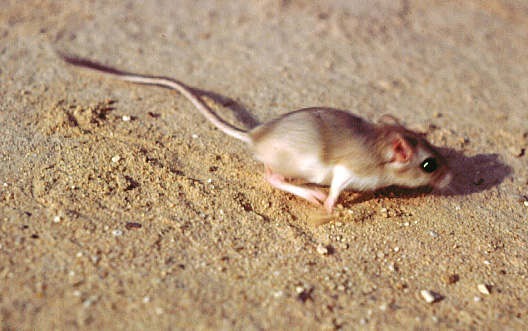
Gerbil running for its life... |
(photo: A. Bouskila) |