Effects of Predation Risk on the Foraging Mode of a Desert Gecko
A. Reichman, A. Bouskila, I. Leitner and J. Falach
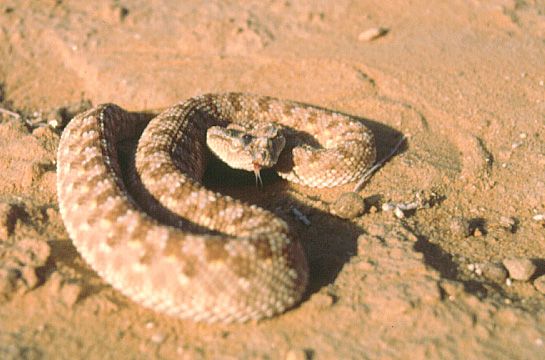
In recent years it has been shown that just the risk of predation is enough to affect the activity of prey, even if the number of prey taken isrelatively low. In a study which focuses on a nocturnal ground gecko, Stenodactylus doriae, the foraging activity of individual geckos is quantified under various conditions. Unlike most other reptiles, geckos are often able to switch their foraging mode between widely foraging and ambush hunting, and this is an excellent opportunity to study the factors that may influence the profitability of various combinations of the two foraging modes. In this study we investigate the effects of presence of snakes (which are among the geckos predators) and the density of arthropods (the prey of the geckos) on the foraging of the S. doriae. Because geckos are visually oriented, both factors may be modulated by thelevel of moonlight, and this possibility is investigated too. Preliminary results collected by Alon Reichmann (an M. Sc. student) showed that the reaction distance of the geckos to prey is larger on moonlit night, andthis may partially explain the increased activity level of the geckos on illuminated nights. Geckos were attracted not only to their prey, but also to the movement of snakes, and this seems to serve the role of predator investigation. This direction will be further investigated by Inbal Leitner, in a semi-natural enclosure in Sede Boqer. The ambush sites and movements of the snakes (Cerastes gasperettii) are investigated by Jacky Falach in same enclosure, and he will determine if snakes prefer to ambush under bushes or in the open, and whether they are attracted in particular to sites with rodents' odor, lizard's- or gecko's odor. The implications of these preferences for the geckos and their predator avoidance will contribute to the understanding of Alon's resultsfrom the field.
 |
|
| C. gasperettii |
(photo: A. Bouskila)
|