Ecological Processes that Determine the Distribution of Two Parapatric Lizards: a Mechanistic Approach
A. Bouskila, Hila Tzachor, Aviad Bar
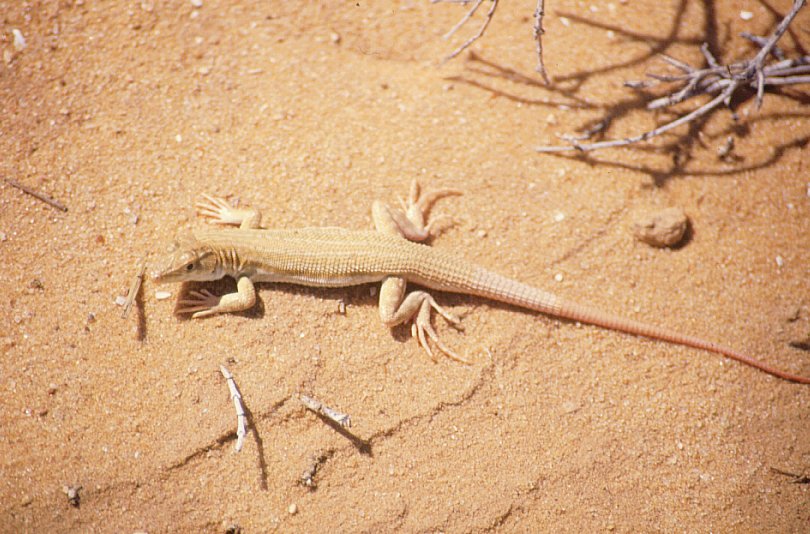
Understanding parapatric contacts of species is important not only to biogeographers, but also to ecologists, because it complements the knowledge that has been accumulated in studies of species coexistence. We have chosen to analyze a case of parapatry between a generalist lizard Acanthodactylus boskianus) and two sand lizards (A. longipes and A. scutellatus) whose contact zone coincides with the boundary between sand and non-sandy soils in the western Negev Desert. This case is particularly interesting, because A. boskianus, which does not penetrate the sand at the boundary, does very well on sand in the central Negev, where the sand lizards are not present. We test several non-exclusive hypotheses regarding the mechanisms that might be involved in the formation of this pattern:
-
A. boskianus is less adapted to the abiotic factors across the boundary with the sand lizards
-
Strong competition with the sand lizards prevents A. boskianus from crossing the boundary between the two species.
-
Lizard predators (e.g.,snakes) on the sand limit the distribution of A. boskianus across this boundary.
Combinations between these hypotheses are possible and will be considered. To test the hypotheses we use several experimental approaches:
-
Measuring locomotor performance of the lizards on different substrates
-
Introduction of A. boskianus in large exclosures on the sand along the boundary of the parapatric contact (competitiors and/or predators are removed in a factorial design)
-
Behavioral observations of the interactions between the two species and their susceptibility to predators.
|
|
|
|
A. boskianus |
(photo: A. Bouskila) |